Blog
What Is AI-Powered Digital Marketing? A Beginner’s Guide
– By Abhinav
Every marketing tool now seems to have an “AI” badge on it, and it’s hard to tell what’s real and what’s a rebrand. This guide answers the basic question, what is AI-powered digital marketing, in plain language. You’ll see how it works, where it’s used, what it can’t do, and how to start learning it without a technical background.
What Is AI-Powered Digital Marketing?
AI-powered digital marketing means using artificial intelligence to run and improve marketing across channels like search, social media, email and paid ads.
A person used to sort through the data and make every decision by hand. Now software finds patterns, predicts what people are likely to do, and drafts or adjusts work at a scale no team could match manually. Strategy still belongs to you. The AI takes over the repetitive, data-heavy parts.
Think of it as a very fast assistant rather than a replacement for the marketer. It can prepare, sort and suggest, but it doesn’t know your business goals unless you tell it, and it doesn’t carry responsibility for the result. You do.
How AI Marketing Works, Explained Simply
Most AI marketing tools do the same three things in a loop:
- Collect data. Clicks, searches, purchases.
- Find patterns. The system learns which behaviours tend to lead to a sale or a signup.
- Take action. It changes a bid, picks a send time, suggests an audience or writes a first draft.
Then the loop repeats. Each new result becomes fresh data, so the system keeps adjusting as people’s behaviour changes.
Predictive AI vs Generative AI
These two get mixed up constantly, and most marketing platforms now use both.
- Predictive AI forecasts outcomes. Which lead will probably convert? Which customer is about to leave? Which product should you show next?
- Generative AI creates things: ad copy, email drafts, image ideas, video scripts.
A quick way to remember it: predictive AI helps you decide, and generative AI helps you produce.
Where AI Shows Up in Digital Marketing
If you’ve run a campaign in the last few years, you’ve probably already touched AI. Here’s where it usually sits.
| Channel | What AI does | Common example |
| SEO | Groups keywords, analyses search results, builds content briefs | Keyword clustering tools |
| Paid ads | Adjusts bids and finds audiences automatically | Google Smart Bidding, Meta Advantage+ |
| Social media | Drafts captions and tracks trends | Social listening tools |
| Suggests subject lines, segments lists and picks send times | Send-time optimisation in email platforms | |
| Content | Outlines, drafts and repurposes | Generative writing assistants |
| Customer support | Answers routine questions | Website chatbots |
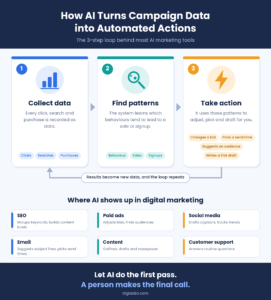
“How AI in digital marketing turns campaign data into automated actions”
This is why AI in digital marketing is less a single tool and more a layer running through the tools you already use.
Simple Examples of AI Marketing in Action
Definitions only go so far. Here are four small, realistic examples of how a beginner might use AI this week.
SEO: grouping keywords
Say you have a list of 300 keywords. Sorting them by topic by hand takes an afternoon. An AI tool can cluster them into groups in minutes, showing which keywords belong on the same page. You then review the groups and decide which topics are worth writing about.
Paid ads: smarter bidding
In Google Ads, Smart Bidding uses Google’s AI to set bids in every auction, working toward a goal you choose, such as a target cost per conversion. It takes signals like device and location into account at the moment someone searches. You set the goal and the budget. The system handles the bid-by-bid decisions.
Email: testing subject lines
Ask a generative AI tool for ten subject line options, pick the three that sound most like your brand, and A/B test them. The AI saves the brainstorming time. Your data decides the winner.
Content: repurposing
Turn a webinar transcript into a blog outline, a few social captions and a short email. The AI produces the first versions. You fix the facts, add your own examples and make sure it sounds like you.
Why Marketers Are Adopting It
- Research and first drafts that took hours can take minutes.
- Messages can be adjusted for different audience segments without building each one by hand.
- Faster testing. You can compare more headlines, creatives and audiences at the same time.
- Better use of data. AI is good at spotting a pattern in a spreadsheet you’d never scroll far enough to see.
What AI Still Can’t Do
This part gets skipped in a lot of guides, so here it is straight.
AI can be confidently wrong. Generative tools invent facts, and they’ll do it in a very assured tone. Give five brands the same prompt and you’ll get five very similar blog posts, which is a real problem if you’re trying to stand out. AI also knows nothing about your customers beyond the data you feed it, and it has no sense of brand judgment or timing. It won’t notice that a cheerful campaign is about to land on the same day as bad news in your industry.
There’s a privacy side too. Personalisation depends on customer data, so how you collect and use it matters, legally and for trust.
The practical rule: let AI do the first pass, and let a person make the final call.
Common Mistakes Beginners Make With AI Marketing
- Publishing raw output. Unedited AI copy tends to sound generic and can contain errors.
- Skipping the fundamentals. Without a clear audience, offer and goal, AI just produces more of the wrong thing, faster.
- Feeding it poor data. Messy tracking or incomplete customer data leads to weak predictions.
- Chasing every new tool. Tools change constantly. A repeatable process matters more than the latest app.
- Ignoring privacy. Check what customer data you are allowed to use, and avoid pasting sensitive details into public AI tools.
How Beginners Can Start With AI Marketing
- Learn the basics first. Understand SEO, paid ads, email and analytics before adding AI on top. AI speeds up a good process, and it speeds up a bad one just as well.
- Pick one task. Something small, like brainstorming subject lines or clustering keywords.
- Try one tool. Compare the result with how you’d normally do it.
- Always review the output. Check facts, tone and anything with a number in it.
- Measure the result. Note how much time you saved and whether performance actually improved.
If you’d rather learn this in a structured way, our AI-Powered Digital Marketing Mastery course covers these fundamentals hands-on.
Frequently Asked Questions
Will AI replace digital marketers?
Not in any way that matters right now. It’s taking over routine tasks, so the value moves toward strategy, judgment and knowing how to direct the tools. Marketers who can use AI well will have an edge over those who can’t.
Do I need technical skills to use AI in marketing?
No. Most tools work through simple interfaces and plain-language prompts. Understanding marketing fundamentals matters much more than knowing how the models work.
What’s the difference between AI marketing and marketing automation?
Marketing automation follows rules you set, like “send this email three days after signup.” AI learns from data and adapts, for example by choosing the best send time per person. Many platforms combine both.
Which AI marketing tools should beginners try first?
Start with what’s already inside the platforms you use: Google Ads, Meta Ads Manager or your email tool. Then add one general-purpose writing assistant for drafts and research.
Is AI-generated content bad for SEO?
Search engines say they reward content that is helpful, original and accurate, however it was produced. The risk isn’t using AI. It’s publishing generic, unchecked text. Use AI for drafts, then add your own experience, examples and fact-checking.
Conclusion
AI-powered digital marketing is regular digital marketing with machine learning and generative AI handling the heavy lifting on data, testing and drafting. It works best when a person who understands the basics is steering. Start small, check everything it produces, and build from there.
When you’re ready to go beyond experimenting, take a look at our AI-Powered Digital Marketing Mastery course.